
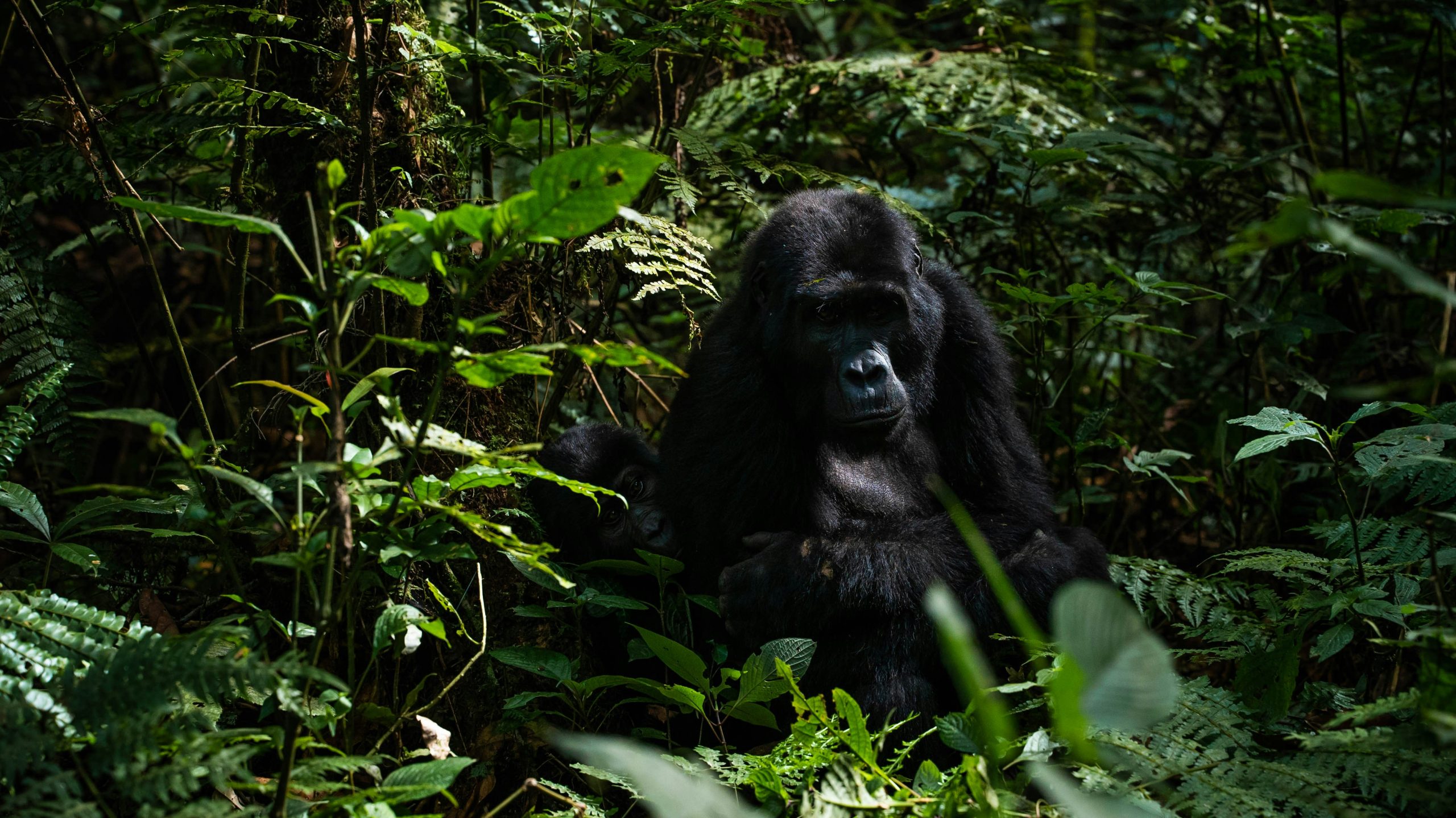
Mountain Gorilla Facts: 25 Things to Know Before Your Gorilla Trek
Few wildlife encounters compare to looking into the eyes of a wild mountain gorilla. These gentle giants share much of our DNA, live in close-knit families and display emotions and behaviours that feel strikingly familiar. Knowing a little about their lives makes a gorilla trek far more meaningful. Whether you are planning to trek in Uganda, Rwanda or the Democratic Republic of the Congo, or simply want to learn more about one of the world’s most remarkable animals, these mountain gorilla facts will help you understand what you are seeing and why conservation matters.
Species and Habitat
1. Mountain gorillas are a subspecies of the eastern gorilla. There are two gorilla species, the eastern gorilla and the western gorilla, each with two subspecies. Mountain gorillas (Gorilla beringei beringei) are one of the two subspecies of the eastern gorilla, alongside Grauer’s (eastern lowland) gorilla.
2. They live in just two areas in the world. Mountain gorillas are found only in two isolated populations: the Virunga Massif, a chain of volcanoes shared by Rwanda, Uganda and the DRC, and Bwindi Impenetrable National Park in south-western Uganda, together with the adjoining Sarambwe Reserve in the DRC.
3. Uganda is home to around half of the world’s mountain gorillas. Bwindi alone holds roughly half the global population, and Uganda’s Mgahinga Gorilla National Park protects part of the Virunga population. See our guides to gorilla trekking in Uganda and Mgahinga.
4. They live at high altitudes. Mountain gorillas live in montane and bamboo forests, typically between around 2,200 and 4,000 metres in the Virungas, and somewhat lower in Bwindi. Their thick, long fur helps them cope with cold nights and frequent rain.
Population and Conservation
5. There are just over 1,000 mountain gorillas left. Combined censuses of the Virunga and Bwindi–Sarambwe populations counted a total of just over 1,000 mountain gorillas, a remarkable increase from a few hundred in the 1980s.
6. They are a conservation success story. In 2018, the International Union for Conservation of Nature changed the mountain gorilla’s status from critically endangered to endangered, thanks to decades of protection, veterinary care, community involvement and well-managed tourism. They are among the very few great ape populations whose numbers are increasing.
7. Dian Fossey brought them to the world’s attention. The American primatologist Dian Fossey studied mountain gorillas in Rwanda from 1967 until her death in 1985, and her book Gorillas in the Mist made them famous. Read about her work in our article on Dian Fossey’s legacy, and learn more from the Dian Fossey Gorilla Fund.
8. They still face serious threats. Mountain gorillas remain vulnerable to habitat loss, snares set for other animals, human diseases, climate change and conflict in the region. Their small, isolated populations make them particularly sensitive to disease outbreaks.
Size and Appearance
9. Adult males are enormous. A fully grown male can weigh around 160 to 200 kilograms or more, roughly twice as much as an adult female. Standing upright, a male can be around 1.5 to 1.8 metres tall.
10. Silverbacks get their name from their backs. When males reach maturity, at around 12 to 15 years old, the hair on their back turns silver-grey, giving them their famous name.
11. Every gorilla has a unique nose print. The pattern of wrinkles on a gorilla’s nose is as unique as a human fingerprint, and researchers use these “nose prints” to identify individuals.
12. Their arms are longer than their legs. Gorillas usually move on all fours by knuckle-walking, supporting their weight on the knuckles of their hands. They can stand and walk upright for short distances.
Family Life
13. They live in family groups. Mountain gorillas live in groups that typically include one or more silverbacks, several adult females, juveniles and infants. Group sizes vary from just a few individuals to more than 30, with around 10 being common.
14. The silverback is the leader and protector. The dominant silverback makes decisions about where the group travels, feeds and rests, settles conflicts and defends the family against threats, including rival males.
15. Females usually give birth to one infant at a time. After a pregnancy of around eight and a half months, a female gives birth to a single infant weighing about two kilograms. Twins are very rare.
16. Infants depend on their mothers for years. Babies cling to their mother’s chest and later ride on her back. They are usually weaned at around three to four years old, and females typically give birth only once every four years or so, which is one reason populations recover slowly.
17. Young gorillas love to play. Juveniles wrestle, chase, climb and tumble, often while the adults rest. Watching them play is one of the most delightful parts of a gorilla visit.
Diet and Daily Life
18. They are mostly vegetarian. Mountain gorillas eat mainly leaves, stems, shoots, roots and pith, including wild celery, thistles, nettles and bamboo shoots in season. Gorillas in Bwindi eat more fruit than those in the Virungas. They occasionally eat ants and other insects.
19. They eat a lot. An adult male can eat around 30 kilograms of vegetation a day. Gorillas get most of the water they need from the plants they eat, so they rarely drink.
20. They build a new nest every night. Each evening, gorillas build nests of folded leaves and branches, on the ground or in low trees, to sleep in. Infants share their mother’s nest. Trackers often use the previous night’s nests to find a group the next morning.
21. Their day follows a routine. A typical day involves feeding in the morning, a long midday rest when adults groom and youngsters play, and more feeding in the afternoon, before building nests at dusk.
Behaviour and Communication
22. They are generally gentle and peaceful. Despite their size and strength, mountain gorillas are shy and calm. Aggressive displays are mostly bluffs, used to warn rivals or perceived threats rather than to attack.
23. Chest-beating is a form of communication. Silverbacks beat their chests to signal their size, strength and presence, especially to rival males, and the sound can carry through the forest. Younger gorillas beat their chests in play.
24. They have a rich vocal repertoire. Gorillas use a wide range of sounds, including contented belch-like rumbles, grunts, barks, screams and hoots, as well as facial expressions and body postures, to communicate with one another.
25. They are very closely related to us. Gorillas share around 98 percent of their DNA with humans. This close relationship is why they are so vulnerable to human diseases, and why trekkers must keep their distance and stay away if they are unwell.
How Gorilla Trekking Helps Conservation
Gorilla tourism is one of the key reasons mountain gorilla numbers have increased. Permit fees fund park management, ranger patrols, veterinary care and research. In both Uganda and Rwanda, a share of tourism revenue goes to communities living around the parks, supporting schools, health centres and clean water projects, and giving local people a direct stake in protecting the gorillas. Tourism also creates jobs for guides, trackers, porters, lodge staff and craftspeople, many of whom live near the parks.
Each habituated gorilla family can be visited by only a small group of trekkers for one hour per day, limiting stress and the risk of disease. By following the rules and choosing responsible operators, visitors play a direct role in the species’ survival.
Where to See Mountain Gorillas
- Bwindi Impenetrable National Park, Uganda: the largest number of habituated groups and a wide choice of trekking sectors.
- Mgahinga Gorilla National Park, Uganda: part of the Virungas, with a habituated group and volcano hikes.
- Volcanoes National Park, Rwanda: easy access from Kigali and spectacular volcanic scenery; see our Volcanoes National Park guide.
- Virunga National Park, DRC: trekking is possible when the security situation allows; always check current advice.
To decide between countries, read our Rwanda or Uganda for gorillas decision guide. For permit information, see how much a gorilla permit costs in Uganda and the Rwanda gorilla permit cost.
Gorilla Trekking Etiquette
- Keep a distance of at least seven metres.
- Do not trek if you are sick; wear a mask if asked.
- Keep your voice low and avoid sudden movements.
- Do not use flash photography, eat or drink near the gorillas.
- If a gorilla approaches or charges, stay still, look down and follow your guide’s lead.
Wondering whether you are fit enough? Read our guide to how hard gorilla trekking is and when to go in our guide to the best time for gorilla trekking in Uganda.
More Gorilla Stories and Guides
- The gorillas of Bwindi
- Face to face with a silverback: a guide’s most profound encounter
- More than a selfie: how your gorilla permit saves a species
- The keepers of the forest: communities who live with gorillas
- Why gorilla trekking is a transformational experience
- I survived Bwindi: a first-timer’s honest account
- Gorilla trekking for older travellers and those with limited mobility
Ready to plan your trek? Read our step-by-step guide on how to book a safari with Kuku Safaris.
Frequently Asked Questions
How many mountain gorillas are left in the world? Just over 1,000, living in the Virunga Massif and in Bwindi–Sarambwe.
Are mountain gorillas dangerous? Habituated gorillas are generally calm around people. Following your guide’s instructions keeps both you and the gorillas safe.
Can mountain gorillas live in zoos? No mountain gorillas live in zoos; they are only found in the wild. Gorillas seen in zoos are western lowland gorillas.
How long do mountain gorillas live? In the wild, mountain gorillas commonly live for around 35 to 40 years.
Meet the Mountain Gorillas
Spending an hour with a mountain gorilla family is one of the most profound experiences in the natural world, and every permit helps secure their future. Kuku Safaris can arrange your gorilla permits in Uganda or Rwanda, along with accommodation, transport and experienced guides. Explore our gorilla trekking packages, and for park information, visit the Uganda Wildlife Authority. Then get in touch to start planning your gorilla adventure.