
Meeting the Maasai: Culture, Customs and Respectful Village Visits
Tall figures wrapped in red cloth, intricate beadwork glinting in the sun, cattle moving across the savannah at dusk: the Maasai are among the most recognisable peoples in Africa, and for many travellers, meeting them is one of the highlights of a safari in Kenya or Tanzania. Yet behind the familiar images lies a rich, complex and evolving culture with deep ties to land, livestock and community. Understanding that culture, and visiting Maasai communities in a respectful and ethical way, makes for a far more meaningful experience.
This guide introduces Maasai history and traditions, explains what to expect on a village visit, offers advice on visiting responsibly and suggests where to experience Maasai culture in East Africa.
Who Are the Maasai?
The Maasai are a Nilotic people who live in southern Kenya and northern Tanzania, across a region that includes some of East Africa’s most famous wildlife areas, such as the Maasai Mara, Amboseli, the Serengeti and the Ngorongoro Conservation Area. They speak Maa, a language shared with related communities such as the Samburu. Oral traditions say the Maasai migrated south from the Nile Valley region several centuries ago, eventually settling in the Rift Valley grasslands, where they became renowned as cattle herders and warriors.
Cattle: The Heart of Maasai Life
Cattle are central to Maasai identity, economy and spirituality. According to tradition, Enkai, the Maasai god, entrusted all cattle to the Maasai. Cattle provide milk, meat, hides and dung for building, and they are a measure of wealth and status. They are exchanged in marriages, given as gifts and used in ceremonies. Goats and sheep are also kept. Traditionally, the Maasai diet relied heavily on milk and meat, and on special occasions on blood drawn from cattle, though today many families also eat maize, beans and other foods.
Homesteads and Houses
Maasai families traditionally live in homesteads known as enkang (often called manyattas by visitors), arranged in a circle and surrounded by a fence of thorny acacia branches to protect people and livestock from predators. At night, cattle are brought into the central enclosure. The houses, called inkajijik, are built by women using a framework of wooden poles plastered with a mixture of mud, cow dung, grass and ash. They are small, low and dark inside, with sleeping areas and a central hearth.
Age-Sets and Rites of Passage
Maasai society is organised around age-sets, groups of men who are initiated together and move through life stages together. Boys become junior warriors (moran) after initiation, and later senior warriors, before becoming elders who make decisions for the community. Important ceremonies mark these transitions. One of the best known is Eunoto, a ceremony in which warriors become elders, involving singing, dancing and the shaving of the warriors’ long, ochre-coloured hair. Women also pass through important stages and ceremonies, and they play key roles in building homes, milking, beadwork and family life.
Dress and Beadwork
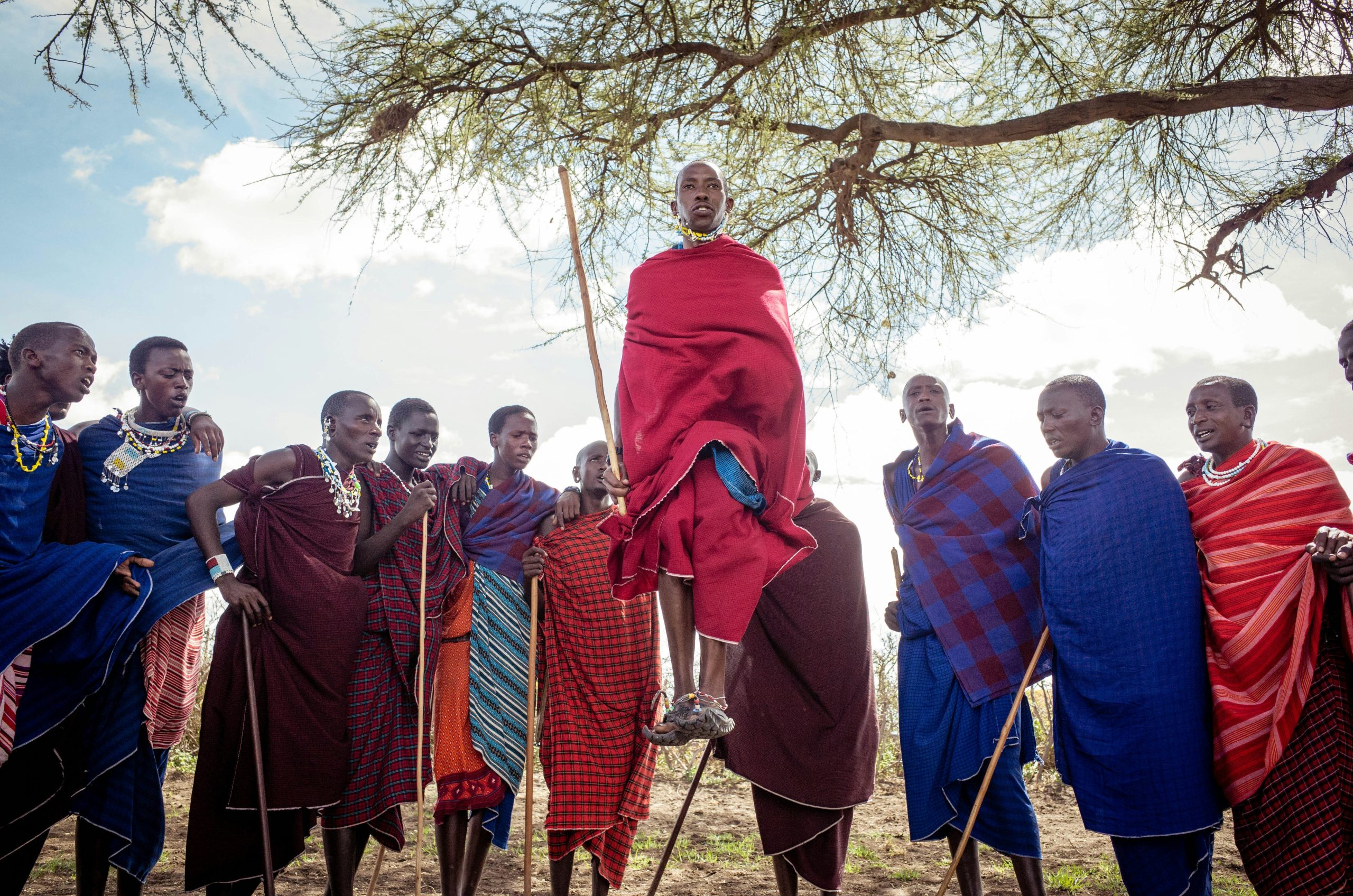
The Maasai are famous for their shúkà, brightly coloured cloths, often red, worn wrapped around the body. Red is said to represent bravery and strength, and it stands out against the savannah. Beadwork is another hallmark of Maasai culture. Women create elaborate necklaces, earrings, bracelets and collars, and the colours carry meanings: red for bravery and unity, blue for the sky and rain, green for the land, white for purity and milk, and so on. Beadwork can also indicate age, marital status and social position.
Music and the Jumping Dance
Maasai music is mainly vocal, with call-and-response singing and deep, rhythmic throat sounds. One of the most famous Maasai traditions is the adumu, often called the jumping dance, in which young warriors take turns leaping high into the air from a standing position while others sing. The height of the jump is a display of strength and fitness. Visitors to Maasai villages are often welcomed with songs and dances and may be invited to join in.
The Maasai and Wildlife
The Maasai have lived alongside wildlife for centuries, and their traditional pastoral practices helped shape the landscapes that safari-goers love today. However, the creation of national parks and reserves, population growth and changes in land use have led to tensions over land, grazing and human-wildlife conflict. In recent decades, community conservancies, especially around the Maasai Mara, have offered a new model. Maasai landowners lease their land for wildlife tourism, earning income while protecting habitats. Staying in these conservancies is one of the best ways for visitors to support both wildlife and communities. In Tanzania, the future of communities in areas such as Ngorongoro remains the subject of ongoing debate about land use, conservation and rights.
A Changing Way of Life
Maasai culture is not frozen in time. Many Maasai today combine traditional pastoralism with education, farming, business and tourism. Young Maasai are doctors, teachers, guides, conservationists and entrepreneurs, while still valuing their heritage. Mobile phones and motorbikes are common sights even in rural areas. Visitors should see the Maasai as a living, modern culture, not a museum exhibit.
What to Expect on a Maasai Village Visit
A typical visit lasts one to two hours. You will usually be welcomed with songs and dances, then shown around the homestead by a guide who explains daily life, house construction, cattle and traditions. You may see a demonstration of fire-making with sticks, visit the inside of a house and learn about medicinal plants. Many visits end at a small market where women sell beadwork and crafts. An entry fee is usually charged, which should support the community.
How to Visit Responsibly
- Choose community-run or well-established visits. Ask your operator how the fee is shared and whether the community benefits directly.
- Ask before taking photos. Always ask permission before photographing individuals, and respect a refusal.
- Be curious and respectful. Ask questions, listen and avoid treating the visit as a show.
- Buy crafts fairly. Bargaining is normal, but remember that crafts are an important source of income for women.
- Stay in conservancies. Lodges in Maasai-owned conservancies channel income directly to landowners and communities.
For more on ethical cultural tourism, see our article on the ethics of cultural experiences, which applies just as much to Maasai visits.
Where to Experience Maasai Culture
Maasai Mara and its conservancies, Kenya. The Mara is the heartland of Maasai tourism. Village visits, walks with Maasai guides and stays in community conservancies offer authentic encounters. See our guides to Great Migration dates and Masai Mara safari costs.
Amboseli, Kenya. Maasai communities live around Amboseli, beneath Kilimanjaro; see our Amboseli safari guide.
Ngorongoro and northern Tanzania. Maasai bomas can be visited near the Ngorongoro Crater and along the road to the Serengeti; see our Ngorongoro Crater safari guide and the Ngorongoro Conservation Area Authority. Communities also live near Tarangire, Lake Manyara and Arusha.
The Rift Valley. Maasai and related communities live around Lake Naivasha and Lake Elementaita, and Samburu culture can be experienced in Samburu.
Combining Culture and Safari
A Maasai village visit fits easily into most Kenya and Tanzania safaris, usually on an afternoon between game drives. Cross-border trips can include both countries; see our guides to Kenya vs Tanzania safaris and combined Kenya and Tanzania safaris. For timing, see our Serengeti migration calendar. For culture-focused trips elsewhere, see our Lake Eyasi Hadzabe and Datoga cultural safari.
Frequently Asked Questions
Is it ethical to visit a Maasai village? It can be, if the visit is organised with the community, fees benefit local families and visitors behave respectfully.
Do Maasai still live traditionally? Many Maasai keep cattle and live in traditional homesteads, while also embracing education, business and modern technology.
Can I take photos in a Maasai village? Usually yes, but always ask permission first.
What should I wear? Comfortable, modest clothing and closed shoes, as homesteads can be dusty or muddy.
Plan Your Cultural Safari
Meeting the Maasai adds depth and humanity to a safari, helping you understand the people who have shared these landscapes with wildlife for generations. Kuku Safaris works with community partners in Kenya and Tanzania to arrange respectful village visits, walks with Maasai guides and stays in community conservancies. Read our advice on choosing a Kenya safari or a Tanzania safari, then get in touch to start planning.