
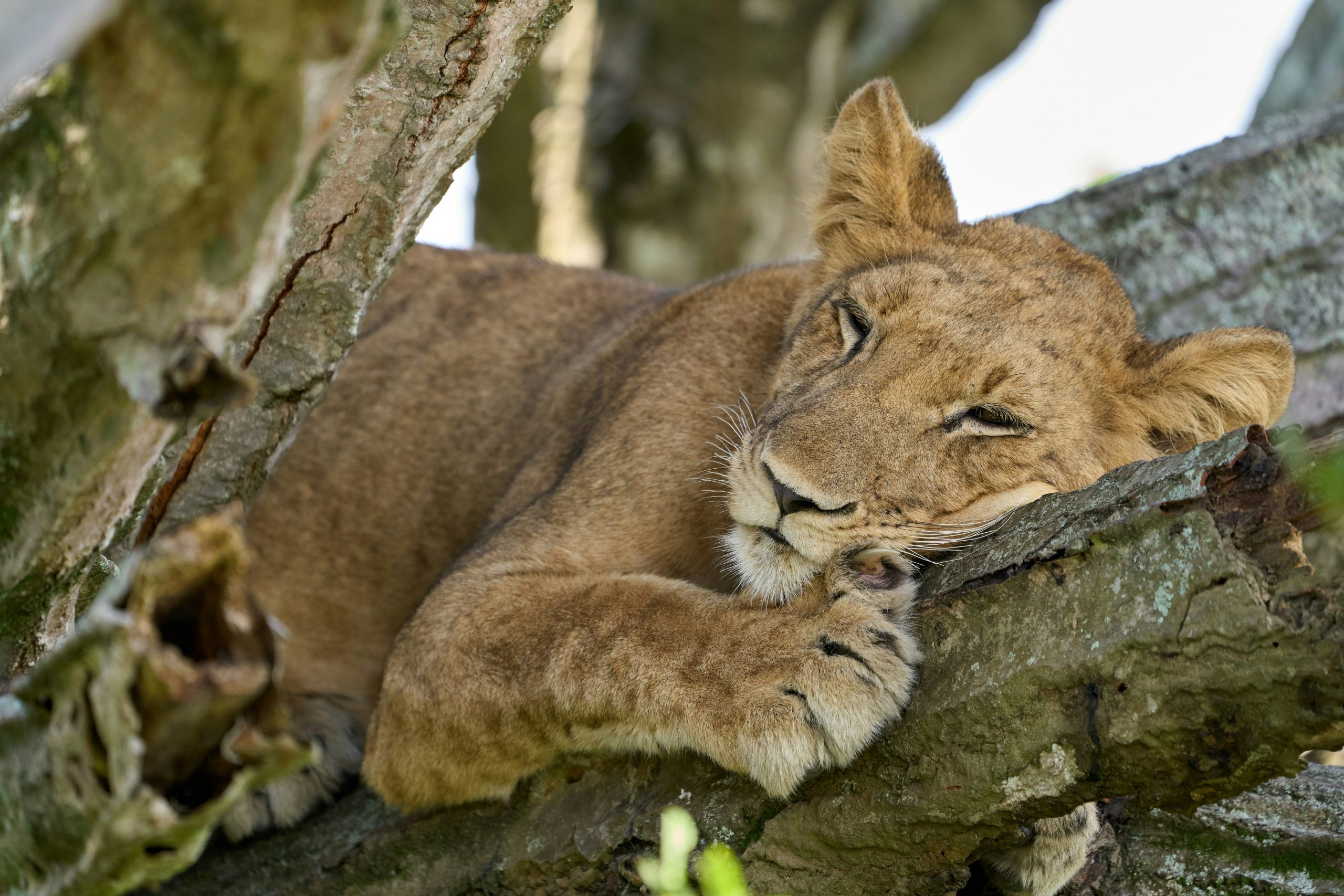
The Tree-Climbing Lions of Ishasha: Uganda’s Most Unusual Big Cats
Lions are not usually known for climbing trees. Heavy and powerful, they spend most of their time resting on the ground. Yet in the remote Ishasha sector of Queen Elizabeth National Park in south-western Uganda, lions regularly haul themselves into the spreading branches of large fig trees, where they lounge for hours, legs dangling, surveying the savannah below. The tree-climbing lions of Ishasha have become one of Uganda’s most iconic wildlife sights and a highlight of many safaris.
This guide explains why these lions climb trees, where and when to see them, how to plan a visit to Ishasha, where to stay, how to combine it with gorilla trekking in Bwindi, and the conservation challenges facing Uganda’s lions.
Where Are the Tree-Climbing Lions?
The tree-climbing lions live in the Ishasha sector, the southern part of Queen Elizabeth National Park, close to the border with the Democratic Republic of Congo. Ishasha is a peaceful, remote area of open grassland, acacia woodland and riverine forest along the Ishasha and Ntungwe rivers. It is far less visited than the northern part of the park, which gives it a wonderfully wild atmosphere. The lions are most often found in large fig trees, especially sycamore figs, scattered across the plains.
Tree-climbing lions are also known from a few other places in Africa, most famously Lake Manyara National Park in Tanzania, but Ishasha is one of the most reliable places to see this behaviour. Read our full Queen Elizabeth National Park safari guide.
Why Do the Lions Climb Trees?
Nobody knows for certain why the Ishasha lions climb trees, but researchers and guides have suggested several explanations, and the truth may be a combination of them:
- Escaping insects: tsetse flies and other biting insects are common at ground level; up in the branches, lions may be bothered less.
- Keeping cool: branches catch cooling breezes during the heat of the day and keep lions off the hot ground.
- A good lookout: from a tree, lions can watch for prey such as Uganda kob and topi grazing on the plains.
- Learned behaviour: cubs learn by watching their mothers, so the habit may be passed down through generations of Ishasha lions.
- Convenient trees: the large, low-branched fig trees of Ishasha are easy for lions to climb.
What You Can Expect to See
A typical sighting involves one or more lions sprawled along thick branches of a fig tree, often several metres above the ground. They may be sleeping, grooming, watching the plains or occasionally climbing up or down, which is fascinating to watch. Sometimes an entire pride, including cubs, occupies a single tree. Lionesses are more commonly seen in trees than heavy adult males, though males also climb. Sightings are frequent but not guaranteed, as the lions move around their territories and may rest on the ground or in thick bush.
Ishasha also offers excellent general game viewing. Look for large herds of buffalo, elephants, topi, Uganda kob, waterbuck, warthogs and, along the rivers, hippos. Birdlife is rich, with many raptors, storks and savannah species.
Best Time to See Tree-Climbing Lions
Time of day: lions are most likely to be found in trees during the warmer hours, from late morning through the afternoon, when they seek shade and breezes. Early morning game drives are excellent for finding lions on the move before they settle into trees.
Time of year: Ishasha can be visited year-round. The dry seasons, from June to September and December to February, offer easier driving and shorter grass, making wildlife easier to spot. The wetter months bring lush scenery and fewer visitors, but some tracks can become muddy. See our guide to the best time to visit Uganda.
How to Get to Ishasha
Ishasha lies on the route between the northern part of Queen Elizabeth National Park and Bwindi Impenetrable National Park, making it a natural stop on a western Uganda safari. From the Mweya or Kasenyi area, it is around two to three hours by road; from Bwindi’s Buhoma sector, around two to three hours. Most travellers visit Ishasha on the way between the northern park and Bwindi, with a game drive en route. The nearest airstrip is Kihihi, which has scheduled flights from Entebbe. See our guide to fly-in safaris in Uganda.
Passing Through or Staying Overnight?
Many safaris pass through Ishasha with a game drive on the way between the northern park and Bwindi. This gives a good chance of seeing the lions, but timing is limited. Staying one or two nights in Ishasha greatly improves your chances and allows you to enjoy morning and afternoon game drives at a relaxed pace. It also lets you experience the peace of this remote area, with the sounds of hippos and lions at night. We strongly recommend staying overnight if your itinerary allows.
Where to Stay in Ishasha
Accommodation in Ishasha ranges from a small luxury tented camp on the banks of the Ntungwe River to simpler lodges and campsites, including a basic Uganda Wildlife Authority campsite. Staying inside or near the sector means short drives to the lion areas. Read our guide to luxury lodges in Queen Elizabeth National Park.
Combining Ishasha With Gorillas
Ishasha’s location makes it perfect for combining savannah and gorillas. A popular route takes travellers from Kibale’s chimpanzees to the Kazinga Channel in northern Queen Elizabeth, then south through Ishasha to Bwindi for gorilla trekking. This route offers primates, savannah game, boat cruises and the tree-climbing lions in about a week. Explore our 7-day Uganda itinerary and our 5-day Queen Elizabeth safari.
Lion Conservation in Uganda
Uganda’s lions face serious threats. Their numbers have declined over recent decades, largely because of conflict with people living around the parks. When lions kill livestock, they are sometimes poisoned in retaliation, and Queen Elizabeth National Park has suffered tragic poisoning incidents in which several lions, including tree-climbing lions in Ishasha, were killed. Habitat loss and snaring also take a toll.
The Uganda Wildlife Authority and conservation partners are working to protect lions through monitoring, community programmes, compensation and education, and through predator-proof livestock enclosures. Tourism plays an important role: park fees fund conservation, and lions that attract visitors demonstrate their value to local communities. In the northern part of Queen Elizabeth, the experiential lion tracking activity allows visitors to join researchers monitoring collared lions, supporting this work directly. Read our article on eco-tourism in Uganda.
Tips for Seeing and Photographing the Lions
- Travel with an experienced guide who knows the favourite fig trees and can read signs of the lions’ movements.
- Bring binoculars to scan distant trees.
- Use a telephoto lens of at least 300mm and shoot from the vehicle.
- Be patient; lions may stretch, yawn or climb down if you wait.
- Stay in your vehicle, keep noise to a minimum and never pressure the lions by driving too close.
- Wear neutral colours and avoid dark blue and black, which attract tsetse flies.
Other Highlights of Queen Elizabeth National Park
- Kazinga Channel boat cruise: huge numbers of hippos, crocodiles, elephants and birds.
- Kasenyi plains: classic game drives with lions, kob and elephants.
- Kyambura Gorge: chimpanzee tracking in a sunken forest.
- Explosion craters: dramatic volcanic landscapes and crater lakes.
- Lake Katwe: traditional salt mining.
Read our guides to Uganda’s 10 national parks and Uganda’s most fascinating wildlife experiences.
Park Fees and Practical Information
Visitors pay a daily park entry fee for Queen Elizabeth National Park, with different rates for foreign non-residents, foreign residents and East African citizens. Activities such as boat cruises, lion tracking and chimpanzee tracking are charged separately. Check current fees with the Uganda Wildlife Authority. Malaria is present in the park, so take prophylaxis and use insect repellent. Read our guide to vaccinations and malaria.
A Day in Ishasha
A typical day in Ishasha begins before sunrise with coffee at your camp, listening to the calls of birds and the grunting of hippos in the river. As the light comes up, you set out on a morning game drive across the plains, looking for lions on the move, herds of buffalo and topi, and elephants browsing in the woodland. Your guide checks the favourite fig trees and looks for fresh tracks. Mid-morning, you return to camp for breakfast and a rest during the heat of the day.
In the afternoon, when the lions are most likely to be lounging in the branches, you head out again. Finding a pride sprawled across a fig tree, with the golden light of late afternoon filtering through the leaves, is a magical moment. As the sun sets, you return to camp for drinks around the fire, dinner under the stars and the night sounds of the African bush.
Lion Behaviour and Social Life
Lions are the most social of the big cats, living in prides made up of related females, their cubs and one or more adult males. The females do most of the hunting, often working together to bring down prey, while the males defend the pride’s territory against rivals. Lions spend much of the day resting, sometimes up to 20 hours, conserving energy for hunting, which often takes place at dusk, during the night or at dawn. In Ishasha, Uganda kob and topi are important prey, along with buffalo, which larger prides can tackle together.
Watching a pride in a tree reveals much about their social bonds: lionesses grooming each other, cubs playing with their mothers’ tails, and the whole group dozing together. Observing these interactions, rather than simply ticking off a sighting, makes the experience much richer.
How to Help Protect Uganda’s Lions
- Visit the parks: park fees fund protection and show the value of lions to local communities.
- Join experiential lion tracking in Queen Elizabeth, which supports research.
- Choose lodges and operators that support community conservation projects.
- Follow park rules and never pressure lions at sightings.
- Share responsible images and stories that raise awareness.
Ishasha vs Lake Manyara
Lake Manyara National Park in Tanzania is the other well-known home of tree-climbing lions. Manyara’s lions are seen less predictably, and the park is known as much for its flamingos, elephants and baboons. Ishasha is generally considered the more reliable place to see lions in trees, and its remote atmosphere offers a quieter experience. Travellers combining Uganda and Tanzania can try to see both. Read our guide to Lake Manyara National Park and our comparison of Uganda vs Tanzania safaris.
Other Wildlife in Ishasha
While the lions steal the show, Ishasha rewards patient wildlife watchers with much more. Large herds of buffalo graze the open plains, sometimes numbering in the hundreds. Elephants move between the woodland and the rivers, and the Ishasha River is home to hippos and crocodiles. Topi, a handsome antelope with a glossy reddish coat and dark patches, are particularly common here, along with Uganda kob, waterbuck, bushbuck and warthogs. Leopards are present but elusive. Black-and-white colobus monkeys and olive baboons can be found in the riverine forest. Birdlife includes martial eagles, bateleurs, African fish eagles, grey crowned cranes and a variety of storks, rollers and bee-eaters, so keep your binoculars handy between lion sightings.
Frequently Asked Questions
Are the tree-climbing lions always in the trees? No. They spend time on the ground too. Sightings in trees are common but not guaranteed.
How long should I spend in Ishasha? At least a game drive on the way to Bwindi; ideally one or two nights to maximise your chances.
Can I see tree-climbing lions elsewhere in Uganda? Lions occasionally climb trees in other parks, but Ishasha is by far the most reliable place.
Is Ishasha suitable for children? Yes. Game drives are suitable for all ages, and seeing lions in trees delights children.
Can I self-drive in Ishasha? Yes, with a 4×4, but a guide greatly improves your chances. See our self-drive safari guide.
See the Tree-Climbing Lions With Kuku Safaris
Our experienced guides know Ishasha well and can build the lions into any western Uganda itinerary, often combined with gorillas in Bwindi. Read about the Uganda Big Five safari, visit the Uganda Tourism Board and see how to book with Kuku Safaris.